Pantone on Fashion by Pantone LLC
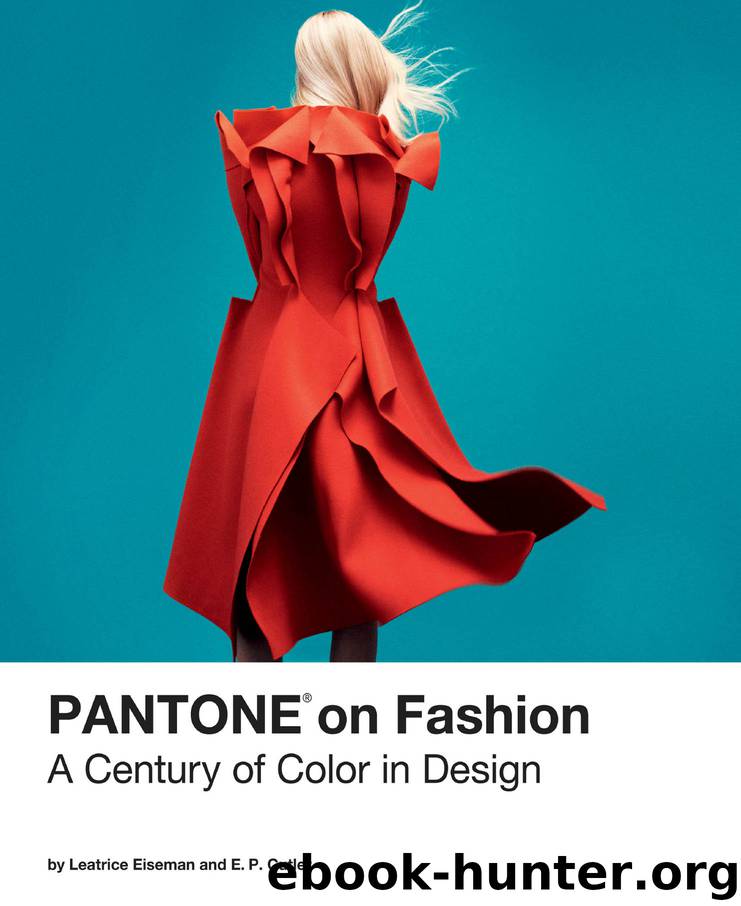
Author:Pantone, LLC [Leatrice Eiseman and E. P. Cutler]
Language: eng
Format: epub
Publisher: Chronicle Books LLC
Published: 2014-08-10T16:00:00+00:00
Coat Tia Cibani for Ports 1961
Fall/Winter 2011
Print ad for the Women’s Army Corps circa 1943
Belted tunic Igor Chapurin
Fall/Winter 2007
Trench coat Christopher Bailey for Burberry
Fall/Winter 2010
Khaki
Whether inevitable or not, war has plagued humanity since its inception. Continual conflict bleeds its way into every aspect of life. The uniforms of combat crossed over into fashion during the Renaissance when sleeves were deliberately sliced to expose the undershirts, mimicking sword-damaged garments. In 1846, Punjab-based English lieutenant Harry Lumsden, tired of casualties caused by the bright red British uniforms in a desert region, dyed his using mud. Other infantry men followed suit, some using ink, coffee, tea, or tobacco juice as dye instead. While not the first to use the earth as camouflage, Lumsden is responsible for the birth of “khaki,” the Urdu word for “mud,” as the name for a color of clothing. In 1884, khaki dye was patented. What originated as army fatigues slowly made its way into the everyday.
To entertain troops during WWII, pinup girl Chili Williams put on short camo shorts and a matching shirt with a few leaves as embellishment, mimicking Eve. The sexiness of Ewing Krainin’s photo, which ran in LIFE magazine on April 10, 1944, was seen as raising morale.
During the 1960s through the 1980s, the meaning of Khaki, military uniforms, and camo became subverted. Rather than symbolizing the courage of soldiers, it was adopted by anti-war protestors to bring visibility to the Vietnam War halfway around the world. Rockers like Frank Zappa and Jimi Hendrix “disrespectfully appropriate[ed] the United States’s iconic military dress” as a visual way of capturing the “youth disillusionment with politics, foreign policy, and suburban consumer culture.”155 In postmodernity, the sign became removed from its signifier, with military uniforms mostly stripped of meaning. Richard Geist, the owner of an Army-Navy outfitter, referred to civilians procuring the items as being like “buying a character.”156
Manchester-born John Richmond’s Covert Green “street chic” skirt from Spring/Summer 2003 references rock ’n’ roll, not the Gulf War. Japanese designer Akiko Ogawa does not hark back to WWII with her Khaki dress; she is merely “pushing the usual edgy envelope” with it.157 Wayne Lee’s Fall 2010 outfit of green and Khaki camo is in the same post-modern vein. Lee, who left war-torn Vietnam as a child, is not making a statement with the army garb, only offering a “look” for consumption. Oscar de le Renta’s Khaki army jacket and shorts for Spring/Summer 2010 is not targeted at female soldiers, but wealthy women on a jaunt to Dubai. Lucien Pellat-Finet’s 2013 camo man-bag is more fit for a weekend trip to the Amalfi Coast than Iraq or Afghanistan.
Download
This site does not store any files on its server. We only index and link to content provided by other sites. Please contact the content providers to delete copyright contents if any and email us, we'll remove relevant links or contents immediately.
The Great Music City by Andrea Baker(33663)
Aircraft Design of WWII: A Sketchbook by Lockheed Aircraft Corporation(32384)
Call Me by Your Name by André Aciman(20733)
The Secret History by Donna Tartt(19472)
The Art of Boudoir Photography: How to Create Stunning Photographs of Women by Christa Meola(18760)
Shoot Sexy by Ryan Armbrust(17853)
Plagued by Fire by Paul Hendrickson(17541)
Portrait Mastery in Black & White: Learn the Signature Style of a Legendary Photographer by Tim Kelly(17107)
Adobe Camera Raw For Digital Photographers Only by Rob Sheppard(17094)
Photographically Speaking: A Deeper Look at Creating Stronger Images (Eva Spring's Library) by David duChemin(16800)
Ready Player One by Cline Ernest(15146)
Pimp by Iceberg Slim(14800)
Bombshells: Glamour Girls of a Lifetime by Sullivan Steve(14220)
The Goal (Off-Campus #4) by Elle Kennedy(13966)
Art Nude Photography Explained: How to Photograph and Understand Great Art Nude Images by Simon Walden(13147)
Kathy Andrews Collection by Kathy Andrews(12093)
The Priory of the Orange Tree by Samantha Shannon(9364)
The remains of the day by Kazuo Ishiguro(9225)
Thirteen Reasons Why by Jay Asher(9122)
